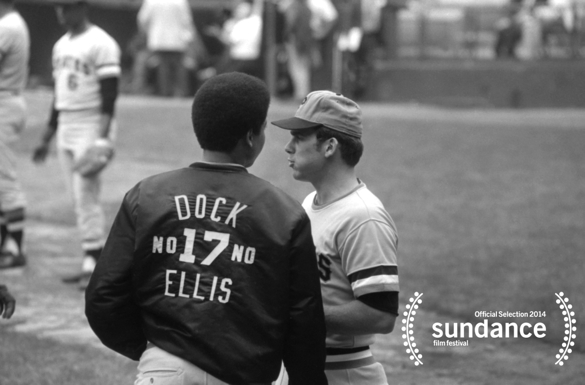
Jerry May and Dock Ellis


Join the Posse

(to receive updates)


Tax-deductible contributions to the film can be made via PayPal. Donations go through to our fiscal sponsor, The Center for Independent Documentary.
Thank you for your support.


Recent Posts


Custom RSS Feeds

RSS Shooting DSLR

RSS Mobile Documentarian

RSS Post Production

RSS Distribution

The Dockumentary

The film ‘No No: A Dockumentary’ is a non-fictional examination of America, baseball, civil rights and drug policy over the past 40 years through the words, deeds and impact of the late Dock Ellis.

Dock Ellis is best known for a no-hitter (or “no no”) he threw while pitching for the Pittsburgh Pirates on June 12, 1970 in San Diego. After his professional baseball career ended, Dock revealed that he was high on LSD that day. He claims to have pitched every game of his professional career high, and that in his time over 90% of ballplayers played under the influence of amphetamines.

Dock Ellis died in December 2008, and spent the latter half of his life as a drug counselor working with troubled youth and prisoners in California. Dock’s honesty about his past was refreshing and inspirational to musicians, artists and countless ordinary people struggling with their own abuse problems.

Advisory Board Members Named

We are pleased to announce the formation of an Advisory Board for the film ‘No No: A Dockumentary‘. These members offer a broad diversity of experiences to complement the production team. We’re proud that this accomplished group of talented individuals supports the project and all wish to see it to completion. We have asked the board members to be available to advise our team and provide insights into interviews, funding and grant proposals, provide creative feedback on the work-in-progress, and on marketing & distribution plans.


Louis Black is co-founder and editor of the alternative weekly The Austin Chronicle and a founder of the South by Southwest Music, Film and Interactive Conferences and Festivals. Louis was an original board member of the Austin Film Society and a past president of that organization. Louis was Executive Producer of ‘Be Here to Love Me: A Film About Townes Zandt‘ and Associate Producer of ‘The Order of Myths‘.


Glen E. Friedman is a world-renowned photographer, artist, and music & film producer who formed a close friendship with Dock Ellis as a boy. Glen’s youth was spent skateboarding in the West Los Angeles area “Dogtown”, and he was both Co-Producer and Creative Consultant for the film ‘Dogtown and Z-Boys‘, which won a 2002 Independent Spirit Award for Best Documentary, and the Audience Choice Award for Best Documentary at the 2001 Sundance Film Festival.


Keith Maitland is the director of the feature-length documentary, ‘The Eyes of Me‘, which premiered at the 2009 SXSW Film Festival, and on the PBS series Independent Lens in 2010. Keith participated in the Director’s Guild of America Trainee Program, and upon completion of the program, became one of the youngest members of the DGA, working alongside directors including Woody Allen, Janusz Kaminski, and Joel Schumacher and on NBC’s ‘Law & Order’.


Ray Shapley is a successful businessman and entrepreneur with a broad range of experience in technology sales and marketing. Ray has served as a trusted advisor to the producers for years. He will provide invaluable expertise to help design an effective social marketing and online advertising campaign to reach potential stakeholders and supporters and develop an audience for the film during the production process. Ray also played baseball at The University of Kansas.


Scipio Spinks is a former Major League Baseball pitcher for the Houston Astros and St. Louis Cardinals, and he was a contemporary and close friend of our film’s subject, Dock Ellis. Scipio is currently a scout for the Houston Astros and has previously coached at two Historically Black Colleges, Jackson State and Texas Southern. Scipio has made it a personal focus to reverse the declining participation since the 1970s of young African-Americans in baseball.


The Muhammad Ali of Baseball

On June 12, 2010 the German newspaper Frankfurter Rundschau managed to find space for an article about the legacy of Dock Ellis among the burgeoning press coverage of the 2010 World Cup. We are now able to provide a professional English translation from the original German with the help of Ursula C. Sturm who graciously offered her services at the bequest of a friend, Markus Wittek.

The original article can be found here.


The Muhammad Ali of Baseball

A game on LSD brought Dock Ellis the fame he deserved – for totally different reasons

By Wolfgang Hettfleisch

(Translation: Ursula C. Sturm, www.translations-that-click.de)

It was an unfortunate twist of events for Dock Ellis. The pitcher for the Pittsburgh Pirates, an MLB team, had used a break in the series versus the San Diego Padres to visit friends in Los Angeles. Enough time, he thought, to have a couple of drinks and joints and then consume some LSD and get high. Unfortunately, the Pirates pitcher sort of lost a day due to his LSD-induced stupor and was still on his trip, when his friends opened the newspaper and found out that he was supposed to play in a couple of hours. The effect of LSD, the most popular drug of the Hippie movement, can last for hours and hours. Ellis had no chance of coming down in time for the game.

The rest of that day 40 years ago was only a vague memory for him. Before the game started, he took some stimulants. Amphetamines were consumed like M&M’s in MLB at that time. Ellis could barely make out the opposing hitter. He only saw the fingers of his catcher, taped with fluorescent tape. The size of the baseball seemed to be as big as a pumpkin one minute and tiny like a golf ball the next. The score never registered with him. The result was a so-called no-hitter, a game where not a single valid hit is achieved by the opposing team. Things cannot get much better than that.

June 12th 1970 did not earn Dock Ellis a place in the Baseball Hall of Fame, but it did make him famous throughout the USA, even though that came much later. The writer and later poet laureate Donald Hall wrote a biography about Dock Ellis, the “different kind of baseball star”, as early as 1976. Before the book came out as a paperback in 1989, the original version, which stated that Ellis had been drunk that day in San Diego, was changed to what actually happened. Ever since, Dock Ellis, who died one and a half years ago, and his no-hitter on LSD have become baseball folklore in America.

Country of Baseball rear jacket

Donald Hall & Dock Ellis (1976)

Poets and bands have taken up the topic, and countless differing and thoroughly embellished accounts circulate on the internet. But these can easily put people on the wrong track, says Jeffrey Radice from Austin, Texas, who is planning to shoot a documentary on Dock Phillip Ellis Junior. Said documentary presents Ellis as a clever, courageous and, most of all, honest man who fought against the baseball establishment, thus becoming a forerunner for a new, proud generation of popular African-American sports stars in the USA.

Dock Ellis constituted what was later called an “Enfant terrible”. Donald Hall called him the Muhammad Ali of Baseball. The man who stated about himself that he never played a single Major League game without being high, was a child of his times. He loved Jimi Hendrix and eccentric outfits. Once he even came to training with curlers in his hair because someone had complained about his hairstyle. And when spectators insulted him with racist comments, he would sometimes climb into the stands to kindly inquire what the problem was and whether it could possibly be solved over a shared dinner.

“He wasn’t perfect, he may not have been particularly noble, but he was human”, says Jeff Radice. This was enough to make the headstrong jock an outsider in professional baseball in the 1970s. Plus he was African-American. The Major Leagues had only been opened for African-American players in the 1940s, when racial segregation in US baseball was abolished and the Negro Leagues, where African-Americans played amongst themselves, were dissolved.

Ellis, who saw himself in the tradition of the civil-rights movement, became an icon for a new, self-confident generation of African-American athletes. Many ambitious African-American athletes decided to play baseball. This trend has long since changed. Today, Latino players dominate the MLB, while most African-American talents decide to play basketball or American football. With his film project “Dockumentary”, Jeff Radice therefore wants to examine a chapter in US sports history which is increasingly falling into oblivion. He quotes Jacques Barzun, a French-American cultural historian, who stated, “To understand America you must first understand baseball.”

Dock Ellis continues to be misunderstood. After his short and sensational career, which brought him a championship with the Pittsburg Pirates and a start in the All-Star Game, he retired in the late 1970s. After that, baseball no longer played a role in his life. He managed to overcome his addictions, became a drug counselor, and spoke openly about a fact that nobody in MLB wanted to hear: that the majority of the players of his time were on something – pretty much anything that would enhance their performance. The steroid scandal involving stars like Mark McGwire and Barry Bonds indicates that the preferred substances may have changed, but the principle has not. Dock Ellis, the flamboyant Ali of Baseball, died in December 2008 at the age of 63 as a result of a cirrhosis of the liver.

Muhammad Ali of Boxing